
- Pray that those who lost their families and properties by the flood disaster would be comforted and restored as soon as possible.
- Pray that Libya's internal conflicts would be peacefully resolved soon, and more foreign supports would help stabilize the country.
- Pray that through this disaster, the Libyan people hearts would be open to the Good News and the true hope found in Jesus Christ.
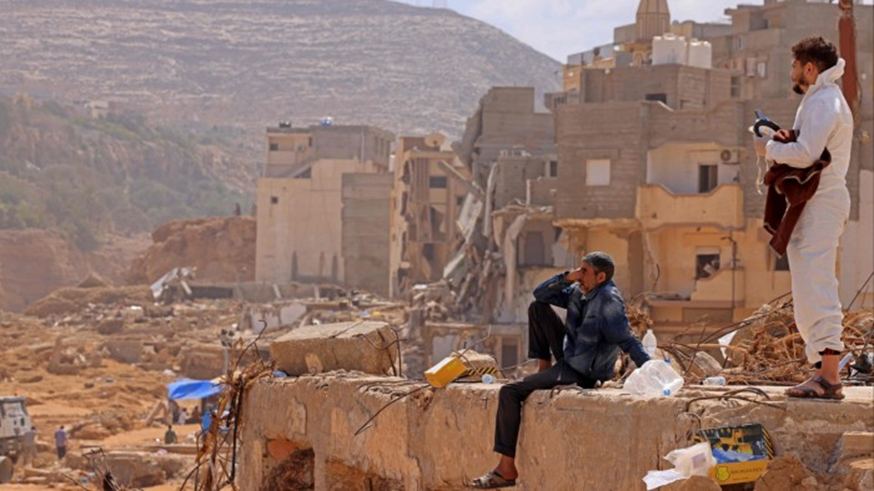 A destroyed building in Libya’s eastern city of Derna. The accountability demanded by many Libyans is highly unlikely to materialise © Karim Sahib/AFP/Getty Images
When Storm Daniel blew across the Mediterranean towards Libya’s eastern coastal region, local officials had ample warning. Days earlier it had caused flooding in Greece, Turkey and Bulgaria that claimed more than a dozen lives. But in Libya no one was prepared for the scale of disaster that was about to unfold. As torrential rains and powerful winds battered the region, two dams in hills above Derna collapsed, spewing out a torrent of water that ripped through the heart of the city.
The exact toll is still unknown, but death certificates have been issued for about 4,000 people. The disaster would have presented challenges for any state. But in Libya there was no functioning state to begin with. Instead, there are competing political factions, notoriously corrupt and backed by militias, which over the past decade have split the country between east and west. They must now bear much of the responsibility for the tragedy that has befallen long-suffering Libyans.
The major damage was caused by the collapse of the two ageing dams that were apparently in a state of disrepair. Experts had long warned about the risk they posed if not properly looked after. But a report by a state-run audit agency two years ago warned that they had not been maintained despite authorities receiving more than $2mn to fix them in 2012 and 2013. As recently as November, a study published by a Libyan university journal warned of fissures in the dams and “disastrous consequences” should they fail.
Few in Libya will be surprised at such negligence. Chaos and conflict have blighted the nation since Muammer Gaddafi was killed in 2011, when a popular uprising morphed into civil war.
Libya was the one Middle Eastern state where the west — in the guise of Nato — intervened militarily to support a rebellion against a despot during the 2011 Arab uprisings. The hope was that democracy would flourish. Instead, Libya became a lesson in the challenges of rebuilding a nation amid the void created by removal of decades of one-man rule. After 42 years of Gaddafi’s brutal, idiosyncratic dictatorship, state institutions were hollowed out, civil society was largely absent and most Libyans had no experience of democratic political processes.
Western nations that participated in Nato’s intervention paid too little attention to the reconstruction process. The US primarily viewed Libya through the prism of counter-terrorism. That shifted in 2019 when Russian Wagner Group paramilitaries were deployed to back Khalifa Haftar, the warlord who controls the east, including Derna. But Libya was long a broken state.
France and Italy, the main European players, often have competing agendas. Regional actors, including the United Arab Emirates, Egypt, Turkey and Qatar, have backed rival Libyan factions to pursue their own interests. UN-led efforts to encourage elections and establish a unified, national administration have foundered.
In an ideal world, the Derna tragedy would act as a wake-up call to Libya’s ruling elite that their nation desperately needs to change course. But the accountability demanded by many Libyans is highly unlikely to materialise as entrenched factions plunder the oil-rich state’s resources.
The disaster ought at least to refocus western governments on supporting efforts to stabilise the country and pressuring political leaders to move to elections. Allowing a failed state on the southern Mediterranean not only betrays the aspirations of Libyans who rose up against Gaddafi, but is a threat to the stability of north Africa. And if Russia, people traffickers and extremists are able to exploit the chaos, western interests will also be endangered.
Resourcehttps://www.ft.com/content/5fd5abd3-161a-4947-8ade-c1ede7143be8