
Midway through a 10-day ceasefire between Lebanon and Israel, hundreds of thousands of Lebanese civilians are returning to their homes and villages after being displaced by escalating violence between Hezbollah forces and the Israeli military.
While the country’s Christian population is largely concentrated in the mountainous areas north of Beirut, some residents from Christian villages in southern Lebanon are returning to find their homes and religious sites damaged or destroyed.
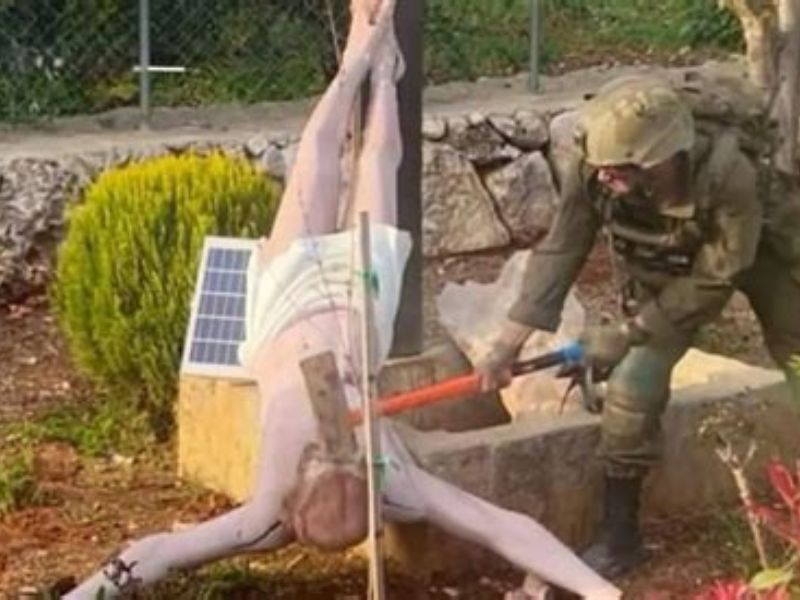
Debl, a Christian village near the border with Israel, was among those hit and has received international attention after a video surfaced showing an Israeli soldier smashing a statue of Jesus with a sledgehammer. The statue, which had been pulled from a cross, was significantly damaged.
The video drew widespread condemnation, including from the highest levels of Israeli leadership. Prime Minister Benjamin Netanyahu said he was “stunned and saddened” by the incident, and the two soldiers involved were removed from combat duty and given 30-day jail sentences just days later.
Italian forces from the U.N. mission in Lebanon replaced the statue with a similar one at the exact location, as International Christian Concern (ICC) confirmed this week. The Israel Defense Forces also posted a photo on Tuesday of a metallic crucifix in what appears to be a nearby location, presenting it as a replacement and expressing “deep regret” over the incident.
Still, the crucifix was not the only object destroyed in recent weeks.
Speaking to the media, Akl Naddaf, the mayor of Debl, stated that multiple homes in the village were destroyed and that Israeli soldiers had broken many statues of saints found inside the homes.
The Maqam Shamoun Al Safa shrine, believed to be the burial place of the Apostle Peter and revered by both Christians and Muslims, was heavily damaged by Israeli shelling during a 2024 operation in southern Lebanon.
Israel Defense Forces also destroyed St. George Melkite Catholic Church in southern Lebanon around the same time.
The Rossing Center for Education and Dialogue, an interfaith advocacy organization based in Jerusalem, documented 155 anti-Christian incidents in Israel in 2025. These included 61 physical attacks on individuals and at least 52 attacks on church properties, carried out by Israeli Jews.
A Delicate Political Balance
Christians make up about 30% to 35% of Lebanon’s population and exercise significant political and social influence in the country, which is home to the region’s highest concentration of Christians.
Joseph Aoun, a Maronite Christian and former military chief, is the current president of Lebanon. He rose to power in January 2025 with 99 out of 128 parliamentary votes — an outcome described by some analysts as a “miracle” after nearly three years of parliamentary gridlock driven in part by Hezbollah’s political influence.
Lebanon’s political system is built on a delicate sectarian power-sharing arrangement that allocates leadership roles by religious identity — most notably reserving the presidency for a Maronite Christian, the prime ministership for a Sunni Muslim, and the parliamentary speakership for a Shia Muslim.
This framework, rooted in the 1943 National Pact and later adjusted by the Taif Agreement, was designed to balance influence between Christians and Muslims. In recent years, however, demographic shifts and political fragmentation have strained this arrangement, with many Christians expressing concern about declining representation and influence relative to the country’s larger and more politically mobilized Muslim populations.
These tensions have been exacerbated by the outsized role of Hezbollah, a Shia Muslim political party and militia backed by Iran. Hezbollah’s military strength and political leverage often overshadow state institutions, raising concerns among many Christian leaders that the balance of power has tilted away from the original confessional model.
At the same time, divisions within Christian factions — between parties aligned with Hezbollah and those opposed — have weakened their collective political voice. As Lebanon faces renewed conflict and instability, these longstanding dynamics continue to shape both governance and the security outlook for Christian communities and their leaders.
Tensions remain high in the region after weeks of intense fighting between Iran, aided by its regional proxies, and the alliance of Israel and the United States. While a tenuous ceasefire is currently reducing kinetic violence, underlying social tensions continue to flare and threaten renewed conflict.
Source : https://persecution.org/2026/04/22/christian-sites-damaged-destroyed-in-southern-lebanon/